

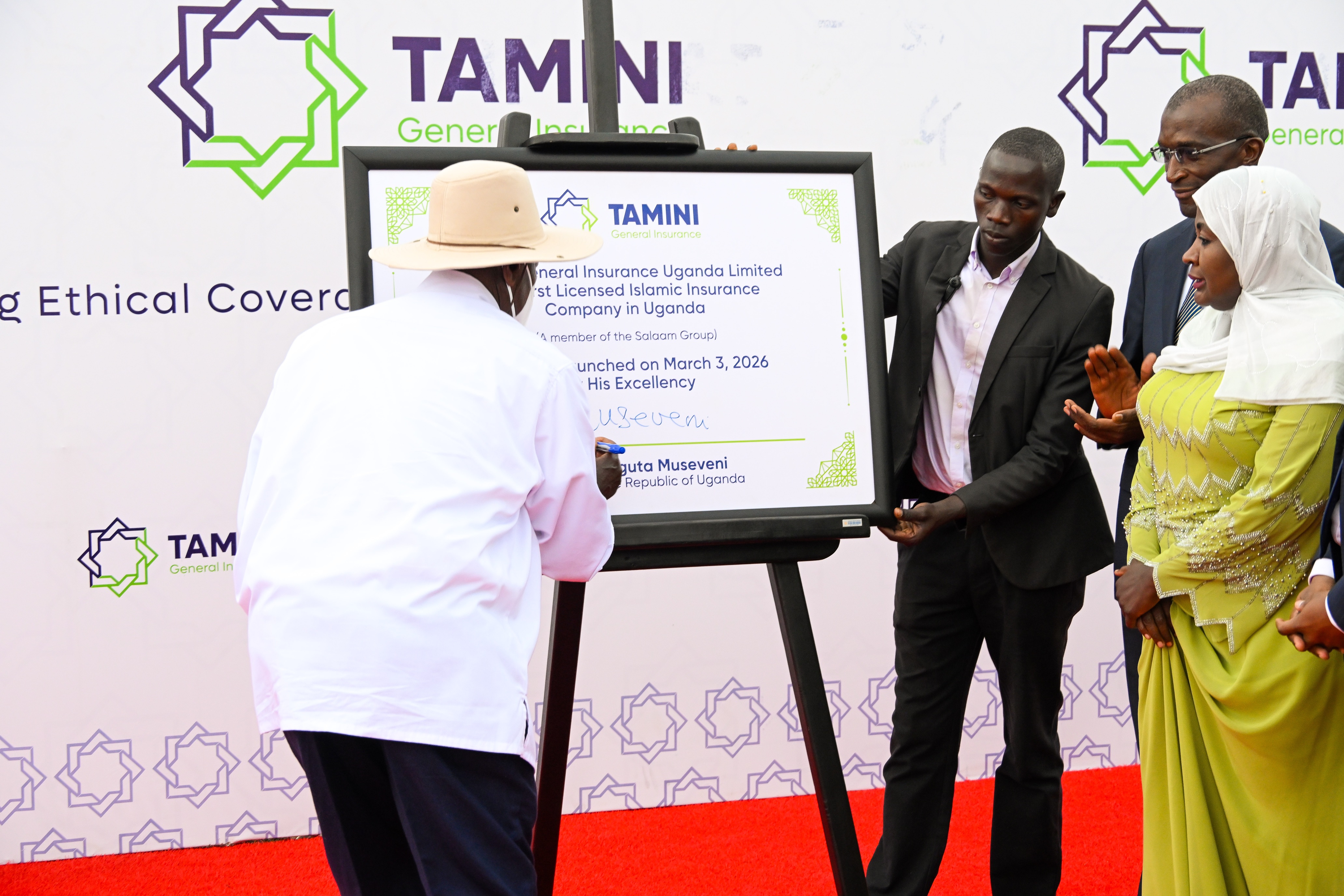
Uganda’s financial sector marked a historic milestone as President Museveni officially launched Tamini General Insurance, the nation’s first Sharia-compliant insurance provider.
The launch, held during an Iftar dinner at Millennium Park, Lugogo, complements the recent entry of Salaam Bank, completing a new Islamic financial ecosystem in the country.
Tamini General Insurance, a subsidiary of the Salaam Group, introduces a Takaful model, which operates on mutual guarantees and collective participation rather than interest-based risk. President Museveni described the initiative as a vital safety net for Uganda’s growing entrepreneurial class.
“Insurance is about backup,” the President noted. “When you borrow to invest, what if things don’t go as planned? I thank Tamini for completing the cycle.”
The model allows, for instance, a farmer to secure Halal financing from Salaam Bank and simultaneously protect the investment through Tamini Insurance. Group CEO Mohamed Bahdon emphasized that this ecosystem, built on ethical investment and transparency, aims to transition Uganda from a consumption-based economy to a production-driven one.
The launch is timely, given Uganda’s population projection of 100 million by 2050. Alhaji Ibrahim Kaddunabbi Lubega, head of the Insurance Regulatory Authority, noted that the country’s insurance sector has grown to over Shs2 trillion.
By tapping into the global Sharia-compliant insurance market, valued at $36.6 billion and expected to double by 2033, Uganda aims to become a regional hub for Islamic finance.
Hajjat Hadijah Namyalo added that Tamini Insurance will target underserved communities, including market vendors and disaster-prone households often ignored by traditional insurers.
President Museveni also announced a strategic adjustment in the Parish Development Model (PDM), directing committees to adopt a matrilineal approach to ensure polygamous and female-led households benefit from government programs.
To support this, he pledged to increase funding for Muslim women’s economic groups from Shs2 billion to Shs20 billion, bringing more Ugandans into the formal money economy.
